8 Dec 2025
When Sindh's ongoing dengue outbreak began in September 2025, for the first time, data from a coordinated provincial laboratory network was used in a structured way to guide the response in real time - identifying hotspots at district level, mapping cases by age and gender, and tracking which diagnostic methods were being used across the province. Around 63,000 laboratory-confirmed dengue cases have now been reported through the Integrated Disease Surveillance and Response (IDSR) Laboratory Network. It is evidence that Sindh's surveillance system is maturing - moving from periodic reporting into actively informing decisions during an outbreak.
Reviewing a province-wide reporting system
The IDSR Laboratory Network in Sindh launched in January 2025 with 49 public sector laboratories. It has since expanded to around 100 laboratories - 56 public and 46 private - with 81% now routinely submitting priority disease data through the DHIS-2 digital platform. The inclusion of the private sector is a significant development, bringing more of the province's diagnostic capacity into a single, shared reporting framework.
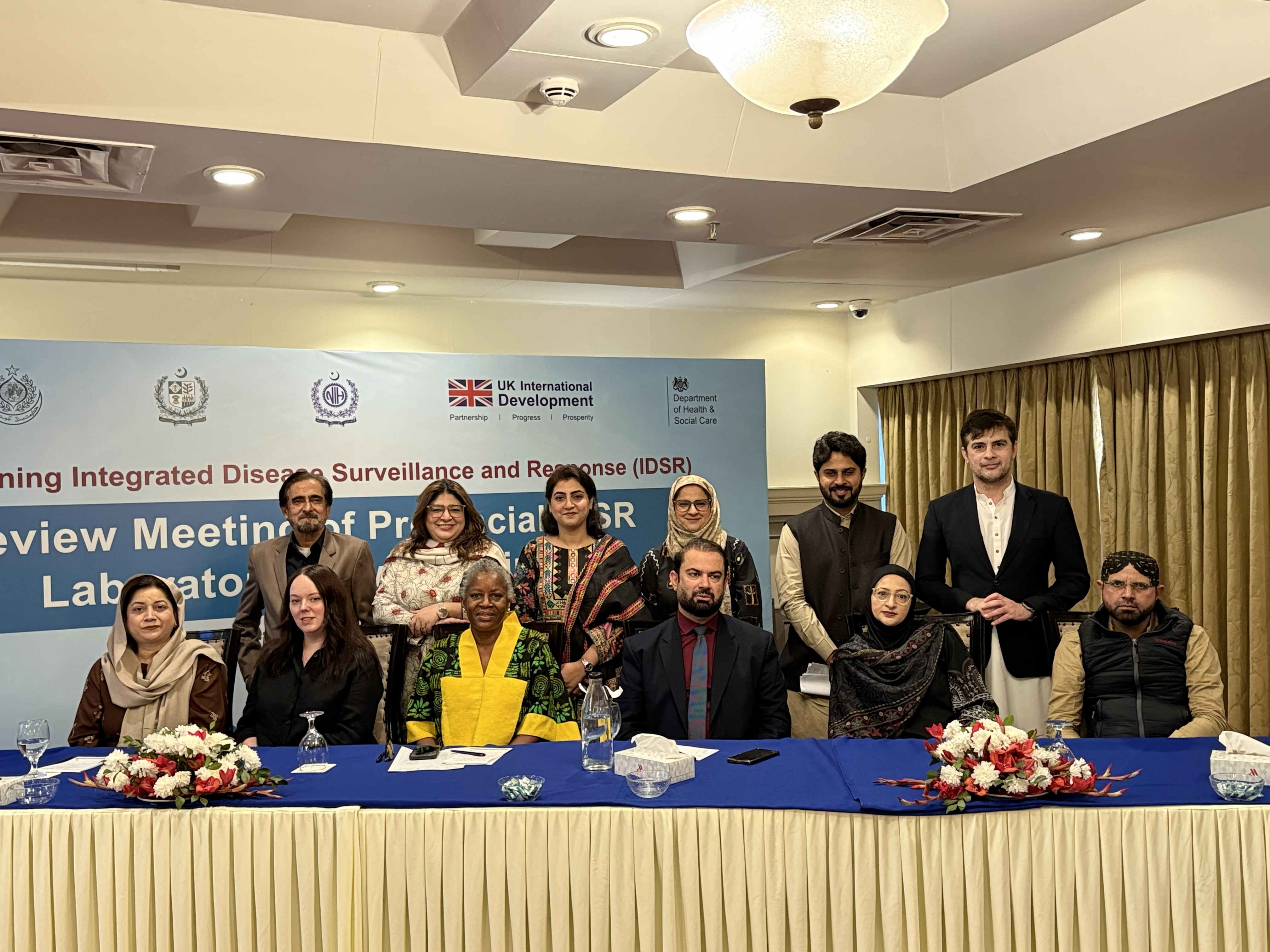
A provincial review meeting held on 5 December 2025 in Karachi brought together laboratory professionals, representatives from the Provincial Public Health Laboratory, the Provincial Disease Surveillance and Response Unit (PDSRU), regulatory authorities, and UKHSA colleagues from Pakistan and the UK. It served as an opportunity to reflect on how laboratory data is currently being used, what progress has been made and where further strengthening is needed. A live demonstration of a provincial laboratory dashboard illustrated how surveillance teams and laboratories can jointly monitor trends and performance - a practical illustration of how the network is being used, not just maintained.
Identifying challenges
The meeting also created space for honest discussion about what still needs to improve. Laboratories raised practical barriers including unreliable internet connectivity, limited access to computers, shortages of trained staff, continued reliance on paper-based systems in many district hospital laboratories, and heavy dependence on rapid diagnostic tests for several priority diseases. The presence of senior provincial health authorities and regulators at the table was significant. It means these will be treated as system-wide issues requiring system-wide solutions, rather than problems for individual laboratories to manage alone.
Priorities identified for the next phase include improving connectivity and equipment access, strengthening diagnostic capacity at district hospitals through methods such as ELISA, and exploring open-source Laboratory Information Management Systems (LIMS) to reduce dependence on costly commercial software - a practical and sustainable approach for resource-constrained settings.
In a concrete show of commitment, the Health Department formally requested technical assistance from the UKHSA IHR Strengthening Project to support implementation of open-source LIMS in district hospitals. This kind of government-led request reflects the growing provincial ownership that underpins lasting change.
Dr Asif Bettani, IHR-SP Deputy Country Lead for Pakistan said: "The progress Sindh has made with its laboratory network is a testament to the dedication of the health professionals and authorities driving this work. Seeing the network guide the dengue outbreak response in real time is exactly why strengthening surveillance systems matters. Going forward, UKHSA will continue to support Sindh's health authorities as they identify and implement the solutions that are right for their context – and that kind of locally-led progress is what builds lasting capacity.”
Next steps for a maturing laboratory surveillance system
The shift to daily, digital, laboratory-confirmed data sharing represents tangible progress towards meeting International Health Regulations. With both public and private laboratories now reporting within a single framework, Sindh has a more complete and integrated picture of disease activity across the province than ever before.
The next phase will focus on closing the remaining infrastructure gaps and challenges - connectivity, equipment, and diagnostic capacity - to ensure the system continues to perform when it is needed most and support faster, better-informed public health action for the people of Sindh.
Also By
Useful Resources
Related Articles
-
Punjab takes critical step in IDSR laboratory network development
BY Dr Muhammad Sartaj, Maimoona Junaid, Dr. Muhammad Saeed Akhtar -
From vision to action: Sindh’s IDSR Lab Network Review marks key progress in Pakistan’s IDSR journey
BY Dr Muhammad Sartaj -
Gilgit-Baltistan launches new laboratory network in efforts to strengthen Integrated Disease Surveillance and Response across Pakistan
BY Dr Muhammad Sartaj, Sumera Abid -
Pioneering training on “District Health Information System-2” to strengthen Integrated Disease Surveillance and Response System in laboratories in Sindh province of Pakistan
BY IHR -
Strengthening Pakistan’s surveillance through provincial laboratory networks
BY Sumera Abid, Muhammad Asif Khan, Dr Muhammad Sartaj
Please Sign in (or Register) to view further.