19 Jan 2026
Countries across the Eastern Mediterranean have taken a landmark step in regional health coordination, establishing the region’s first formally structured Community of Practice to move collaboration from reactive response to sustained, system-wide partnership.
The agreement came out of a workshop convened in Jordan by the Eastern Mediterranean Public Health Network (EMPHNET) and UKHSA’s International Health Regulations Strengthening Project (IHR-SP), bringing together public health professionals from Pakistan, Iraq, Jordan, Egypt and Morocco.
The workshop addressed one of the region's most pressing preparedness gaps: the tendency for multi-sector coordination to only kick in during emergencies, rather than functioning as a routine, embedded part of health systems.
Why multi-sector coordination matters
The workshop confronted this challenge directly, building directly on earlier Multisectoral Coordination efforts supported by UKHSA across the region. Initial engagement helped countries understand the importance of coordination but highlighted gaps in formal structures, routine functioning and cross sector alignment. This latest phase focused on moving from awareness to operationalisation, providing countries with practical tools, structured approaches and a platform to sustain collaboration.
The discussions focussed on eight priority thematic areas spanning One Health approaches and Points of Entry, exploring both the structural and practical dimensions of coordination, including information sharing, joint decision-making, communication across sectors, leadership, accountability and response mechanisms.
A simulation exercise, designed and facilitated by UKHSA, brought the stakes into sharp focus, revealing in real time how cross-sector communication and decision-making holds up under pressure using realistic scenarios, allowing the participants to test how their system functions in practice rather than in theory. The exercise highlighted where coordination works well — and where it doesn't.
A region at different stages, learning together
Discussions confirmed that while multisectoral collaboration is well understood in principle across the region, it is not yet firmly embedded in practice. Regular cross-sector forums are limited in many countries, and the structures that define roles, leadership and accountability are still developing.
Variation between countries also created an unexpected asset. Because participants were at different stages of progress, peer learning became one of the workshop's most valuable outcomes - with countries exchanging practical insights drawn from real experience.
Building momentum
The newly agreed Community of Practice will provide an ongoing platform for countries to share tools, exchange experiences and sustain the connections built in Jordan. Around 15 participants from five countries contributed to both in-person and virtual discussions, with clear commitment to continue engagements through follow up sessions and future workshops.
The ambition is clear: a region where coordinated health security is not a response to crisis, but a routine capability - one that means countries are better prepared for threats that have not yet emerged.
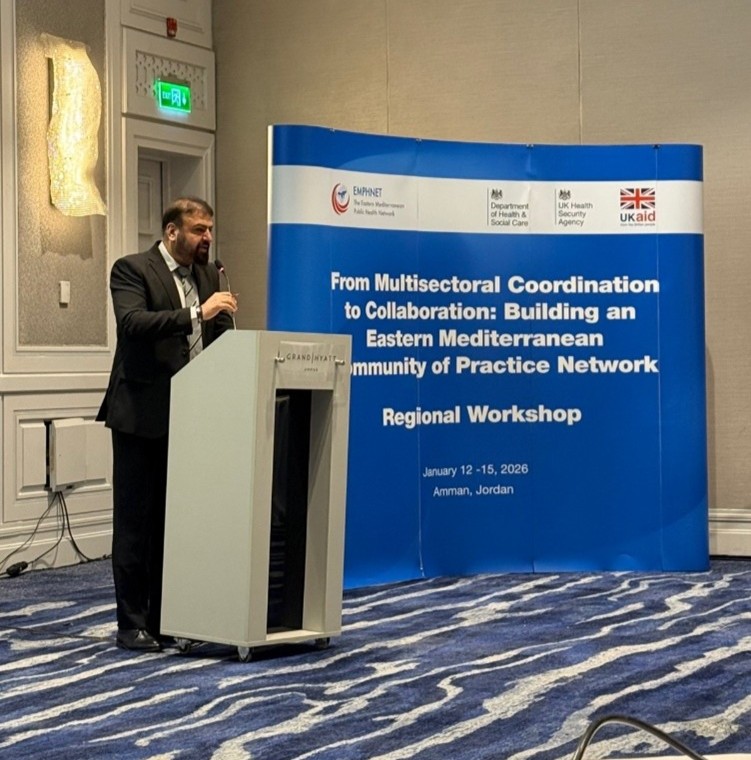
Image above: Dr Muhammad Sartaj, IHR-SP Regional Lead for the Eastern Mediterranean Region, speaking at the workshop.
Also By
Useful Resources
Related Articles
-
First-of-its-kind Community-Based Surveillance Training in Mardan to Boost Pakistan’s Disease Preparedness and response
BY najmajavedawan, Mirza Zeeshan Iqbal Baig, Nadia Nisar, Dr Muhammad Sartaj -
IHR-SP supports the Senior Leadership Symposium of the Nigeria Centre for Disease Control and Prevention
BY IHR -
Cross-continental learning builds ASEAN’s Public Health Emerging Leaders
BY Paul Furtado, Dingase Faith Mvula, Inneke Suhanda -
Fourth Regional Training of Trainers on Public Health Emergency Operations Centres in Africa
BY IHR -
From Nigeria to The Gambia: IHR-SP advances cross-sectoral leadership in public health
BY Paul Irabor
Please Sign in (or Register) to view further.