1 Jun 2026
When Punjab saw evidence of community transmission of Mpox in 2026, it marked a turning point. Until then, cases in Pakistan had mostly been linked to international travel, and the response had focused on strengthening laboratory testing capacity. Community transmission in Punjab changed the picture: detecting and managing Mpox effectively would now need to move beyond laboratory diagnosis alone and involve the entire pathway from early detection to response.
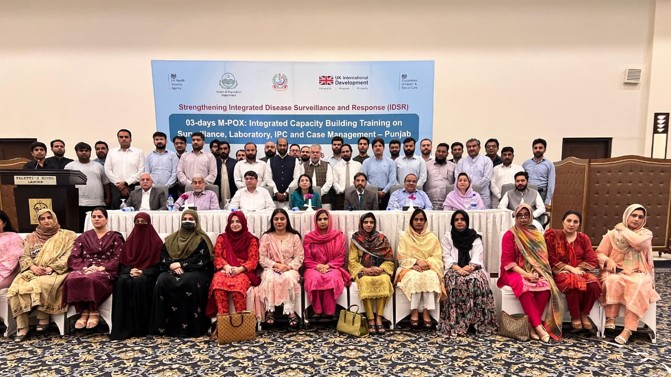
In response, the Government of Punjab, with support from the UKHSA International Health Regulations Strengthening Project (IHR-SP), designed and delivered an integrated Mpox training programme reaching all 36 districts of the province, the first of its kind to bring surveillance, laboratory diagnosis infection prevention and control, and patient management in a single programme.
From laboratory testing to whole-pathway preparedness in Punjab
Each district nominated three key professionals: a District Disease Surveillance Officer, a Head of Pathology or Microbiology, and a dermatologist. Bringing these professionals together helped connect the three key areas of Mpox response - surveillance, laboratory diagnosis and clinical care.The involvement of dermatologists reflects an intention to strengthen understanding of the clinician's role not only in patient care, but also in early recognition, timely reporting and supporting the wider public health response to Mpox.
Delivered in three cycles of training in May 2026, 108 professionals took part in the three-day training sessions covering the full pathway from detection to response. Day one focused on disease surveillance, including recognising and reporting suspected cases and investigating outbreaks,a component co-developed and co-delivered by UKHSA and the Government of Punjab. Day two covered laboratory testing, safe specimen collection and handling, biosafety, infection prevention and reporting of results, drawing on the expertise of the UKHSA laboratory strengthening team who developed and delivered this part of the programme. The final day focused on clinical care, including recognising Mpox, distinguishing it from other similar illnesses, patient management, referral and management of complications.
Using group discussions and realistic outbreak scenarios, the training's main achievement was practical: helping different parts of the public health response better understand their respective roles and how to work together for a timely and coordinated response when a suspected Mpox case is identified.

The multiplier effect: local teams are now training their own workforce
Since the initial sessions, master trainers from the 36 districts have now started running their own cascade training, using the same materials and their own district resources. An estimated 470 additional healthcare workers have been trained this way to date.
This district-led approach demonstrates strong local ownership and supports the sustainability of the training model. By empowering district teams to share knowledge and skills within their own health systems, the programme creates a multiplier effect that extends learning to frontline healthcare workers and strengthens Mpox preparedness across Punjab without needing further external input.
Built on earlier successes
This programme builds on earlier successes following Pakistan's first confirmed Mpox case in 2023. At this time, the National Institute of Health (NIH) and UKHSA IHR-SP developed the country's first Mpox laboratory training module. In 2024, following the WHO's declaration of Mpox as a Public Health Emergency of International Concern, laboratory-based training sessions were cascaded at all four provincial Public Health Reference Laboratories to enhance provincial preparedness for MPXV testing. That earlier work trained over 100 laboratory professionals and enabled provincial laboratories to test 806 suspected specimens, identifying around 70 positive cases whilstreducing the need to send samples to national level for testing. This groundwork gave Punjab's newer, wider training programme a strong foundation to build on.
Prof Saira Afzal, the Dean of the Institute of Public Health, Punjab, reflected on the significance of the shift: "The progression from laboratory capacity building to integrated district-level preparedness reflects the growing maturity of Pakistan's response to emerging infectious disease threats. Bringing surveillance officers, laboratory professionals and clinicians together helps strengthen coordination and ensures that each part of the response works as one connected system. The cascade trainings led by district teams are particularly encouraging, as they demonstrate strong local ownership and help extend preparedness to frontline healthcare workers."
Looking ahead
The latest training marks an important milestone in Punjab - building a more connected Mpox response across all 36 districts of the province.
Punjab's experience offers a practical and sustainable model that other provinces and countries facing similar infectious disease threats may find useful to adapt: this integrated approach helped ensure that surveillance teams, laboratories and clinicians are better prepared to work together throughout the cycle of preparedness, detection and response.With continued technical support and partnership, there is scope to extend this model to other provinces, helping to build a more consistent and coordinated approach to infectious disease preparedness across the country.
Also By
Useful Resources
Related Articles
-
Sharing evidence to strengthen regional partnership for health security
BY Inneke Suhanda, Maimoona Junaid, Ahmed Razavi, Sumera Abid, Muhammad Asif Khan -
Pioneering training on “District Health Information System-2” to strengthen Integrated Disease Surveillance and Response System in laboratories in Sindh province of Pakistan
BY IHR -
Gilgit-Baltistan launches new laboratory network in efforts to strengthen Integrated Disease Surveillance and Response across Pakistan
BY Dr Muhammad Sartaj, Sumera Abid -
From vision to action: Sindh’s IDSR Lab Network Review marks key progress in Pakistan’s IDSR journey
BY Dr Muhammad Sartaj -
From reporting to dengue response: Sindh reviews progress of Provincial IDSR Laboratory Network
BY Sumera Abid, Muhammad Asif Khan, Dr Muhammad Sartaj
Please Sign in (or Register) to view further.