7 Sep 2026
Following the recent Ebola Virus Disease (EVD) outbreaks in the Democratic Republic of Congo (DRC) and Uganda, Zambia remains at risk due to its extensive cross-border movement and role as a regional transit hub. To address the risk of importing high-threat infectious diseases, the country has continued to strengthen its readiness and response capacities. Through technical and financial support, the UK Health Security Agency IHR Strengthening Project (UKHSA IHR-SP) has helped enhance surveillance and laboratory systems, build workforce capacity, improve emergency coordination, strengthen preparedness planning and technical guidance, and test operational readiness through training and simulation exercises. These efforts, implemented in collaboration with the Ministry of Health (MoH) and the Zambia National Public Health Institute (ZNPHI), have contributed to improving Zambia’s ability to prevent, detect, and respond effectively to Ebola and other Viral Haemorrhagic Fevers (VHFs).
Testing National Readiness Through an Ebola Field Simulation Exercise
A field-scale Ebola Simulation Exercise (SIMEX) was conducted at Kenneth Kaunda International Airport (KKIA) and the University Teaching Hospital (UTH), led by the Ministry of Health and ZNPHI with technical and financial supportfrom the IHR Strengthening Project’s Emergency Preparedness Resilience and Response Team and national and international partners.
The exercise simulated the detection and management of a suspected Ebola case entering Zambia, testing critical response functions including screening at points of entry, case notification, safe patient transport, emergency response coordination, infection prevention and control, laboratory processes, case management, and multisectoral incident management.
Key participants and stakeholders included Zambia Airports Corporation Limited, Immigration Department, Zambia Revenue Authority, Defence and Security Wings, the Disaster Management and Risk Division (DRMD), WHO, UNICEF, East, Central and Southern Africa Health Community (ECSA-HC), Africa CDC and US CDC.
The exercise helped identify operational gaps, strengthen coordination mechanisms, and enhance Zambia’s preparedness for a potential Ebola importation event.
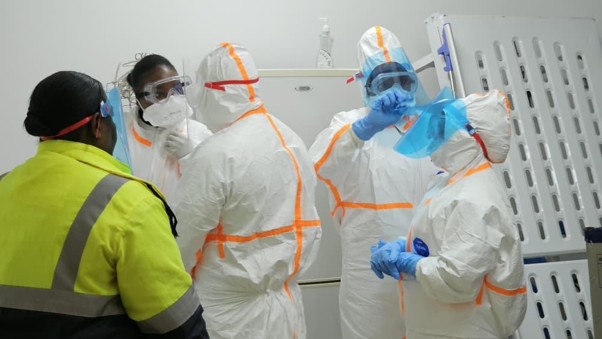
Image: Airport staff donning personal protective equipment during the simulation exercise
Building Frontline Capacity Through Integrated VHF Training
Recognising that preparedness begins with a skilled workforce, the UKHSA IHR Strengthening Project supported the implementation of Integrated Viral Haemorrhagic Fever (VHF) training in several high-priority districts with significant cross-border movement and transit activity, including Chililabombwe, Chingola, Solwezi, Mushindamo and Mansa, to ensure that frontline workers remain alert and capable of rapidly identifying and responding to suspected cases before outbreaks can spread.
The training brought together surveillance officers, clinicians, laboratory personnel, environmental health practitioners, and rapid response teams from district and facility levels, reaching 210 public health workers and clinicians and strengthening coordination and Ebola preparedness. The integrated approach ensured that participants gained competencies across the entire emergency response continuum, from surveillance and case detection to laboratory coordination, infection prevention and control, risk communication, and case management.
Through practical exercises, EVD scenario-based discussions, and review of national response procedures, health workers enhanced their understanding of outbreak management principles and reinforced their role in protecting communities from emerging public health threats.
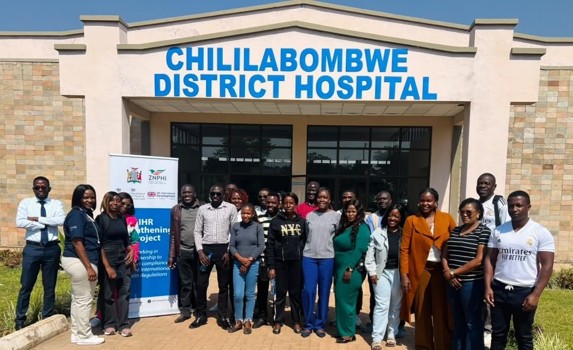
Image: Participants at the training at Chililabombwe District Hospital
Strengthening Preparedness Planning and Technical Guidance
Beyond training and simulation exercises, IHR-SP has supportedbroader preparedness efforts, including reviewing and strengthening Zambia’s National Viral Haemorrhagic Fever Contingency Plan – the strategic plan that sets out how Zambia should prepare for and respond to Ebola and VHFs so that it reflects current risks, meets international standards, and takes on board lessons learned from recent readiness assessments.
As part of this, support has gone into developing and improving technical guidance and Standard Operating Procedures (SOPs) that frontline teams rely on during an outbreak. This includes a specimen referral guide for safely and efficiently transporting patient samples to laboratories for testing, and a contact tracing guide for identifying and following up with people who may have come into contact with an infected person, helping ensure that potential cases are identified quickly and that follow-up support reaches communities and is sustained over time.
This work is part of a wider ‘One HMG’ approach. It links UKHSA’s technical support with other parts of the UK government, including the UK Emergency Medical Team’s (UK EMT) expertise in treating patients, FCDO’s investment in priority treatment centres and the facilities needed to support them, and British High Commission senior level diplomatic engagement. Together, this joins up practical, on-the-ground work with wider planning, investment and high-level decision making. This approach supports the long-term goal of building sustainable systems in Zambia to detect, diagnose, trace, coordinate, refer and clinically treat high-consequence infectious diseases, extending well beyond the current Ebola threat.
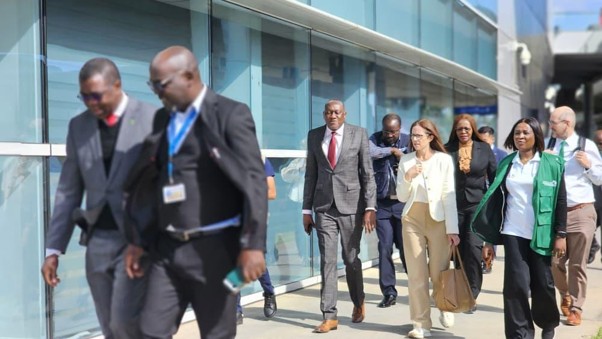
Image: Senior Leadership team from MOH, ZNPHI and British High Commission
Useful Resources
Related Articles
-
Fourth Regional Training of Trainers on Public Health Emergency Operations Centres in Africa
BY IHR -
Supporting Zambia to prepare and respond effectively to mpox
BY ihr -
Advancing multisector collaboration in the Eastern Mediterranean Region for global health security
BY Dr Muhammad Sartaj -
Africa CDC PHEM Fellows receive first training on chemical, biological, radiological and nuclear hazards
BY Eyob Getachew Tensaw, Lydia Izon-Cooper, Addisalem G Taye -
Pakistan tests emergency response to a simulated Ebola case at its borders
BY najmajavedawan, Muhammad Asif Khan
Please Sign in (or Register) to view further.